

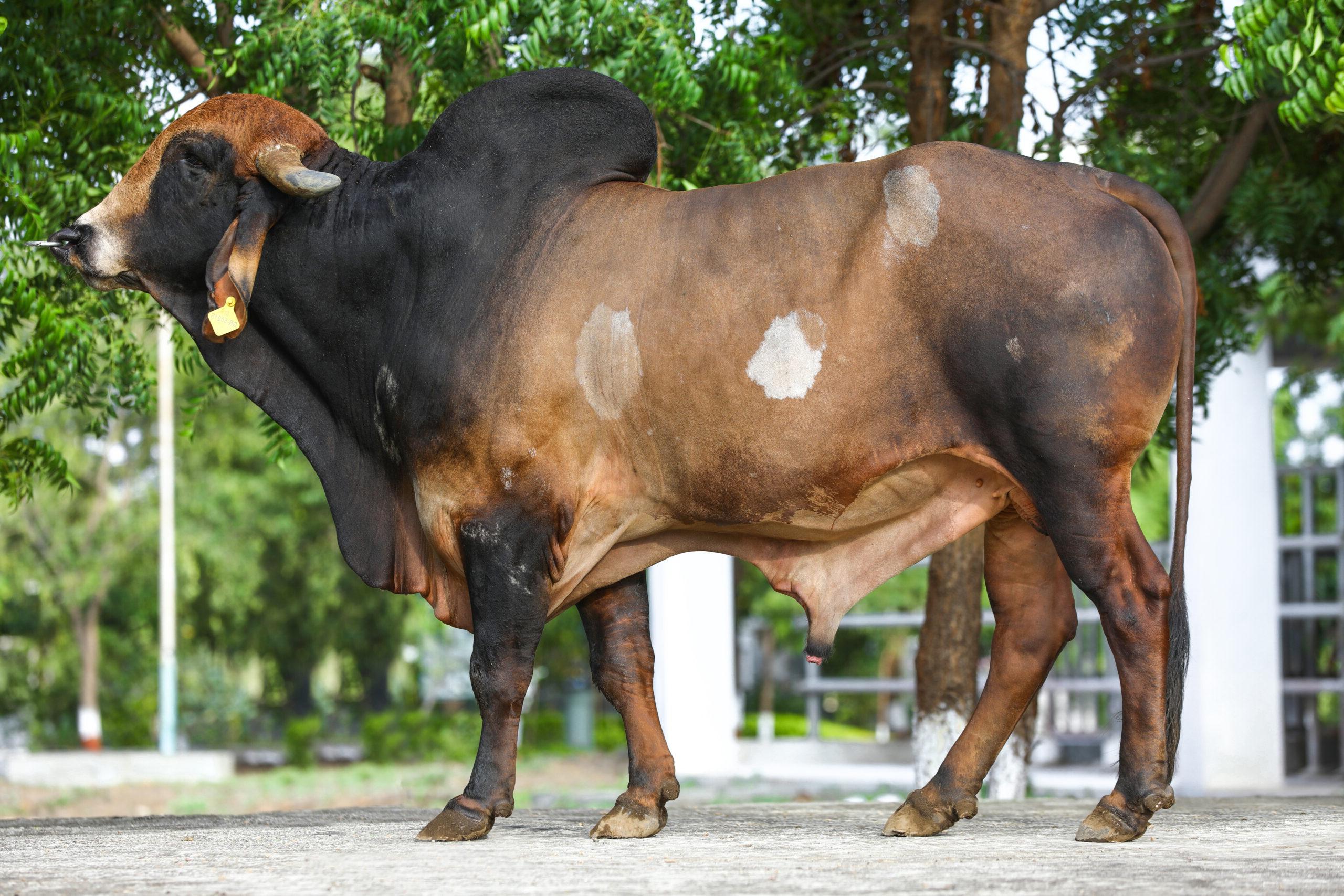
GR-50215
Gir sire by Manek. Dam best lactation 3836 kg at 5.3% fat — highest dam fat in this set. Sire’s dam 4132 kg.
- RHR-GR-50215
- 11 February 2016
- 3836 kg · 5.3%
- 1*
On the card
Traceable name, line, and programme status as published.
- Registered name
- GR-50215
- Bloodline / sire line
- Manek
- Tag / INAPH
- RHR-GR-50215
- Date of birth
- 11 February 2016
- Sex
- male
- Programme
- Semen / AI
- Location note
- Semen station circuit (Rahuri directory)
- Status
- active
Selection figures before daughter proofs
Sire's dam best lactation: 4132 kg — paternal granddam milk depth on the card.
Why dam kilograms matter
Young AI bulls are judged largely by the dam's recorded lactation and fat. NDDB mean sits near 2,573 kg; only about 1.63% of recorded cows clear 4,000 kg. Read this figure against that curve — not Holstein expectations.
Parentage as published
Limited to the public card and research harvest. Missing generations stay blank — not invented.
Pedigree extract · Rahuri Semen Station · INAPH RHR-GR-50215 · Source card
Female
Sire's dam (Manek line)
paternal granddam
Best lact. 4132 kg · Sire's dam best lactation yield (kg) on card
Male
Manek
Manek
Named sire on GR-50215 card (also Manek × 340140764465 in public posts)
Female
340140-764465
340140-764465
Best lact. 3836 kg · Fat 5.3% · Highest dam fat % among the five researched sires
Male
GR-50215
GR-50215
Manek · score 90
Dam fat 5.3% is above typical Gir literature means (~4.6–5.1%). Star rating 1*.
- 3836kg
- 5.3%
- 4132kg
Sire on card: Manek
From station bull to dose
- 01
Health & quarantine clearance
- 02
Collection under hygiene protocol
- 03
Motility, morphology, concentration
- 04
Freeze, LN₂ inventory, labelled dispatch
Field heat detection, timing, technician skill, and nutrition still decide AI success. The straw is one link.
Science that frames every dossier
Morphology
Red coat predominant (~80%); red with white spots common. Convex forehead, pendulous leaf-like ears with terminal notch, lyre/half-moon horns, thoracic hump, loose skin and dewlap for heat dissipation.
A2 tendency
High A2A2 frequency in literature for Gir does not replace lab genotyping for an individual animal — not printed on these cards.
Heat hardiness
As a tropical zebu, Gir is selected historically under heat, sparse forage, and parasite pressure.
Primary references
- Public station bull card
- Best dam fat % in set (5.3%). Sire on card: Manek. Source: https://rahurisemenstation.com/bull/gr-50215/
- NDDB Gir development booklet